


After barely surviving their road to the Western Conference semifinals while many fans followed Crickex Affiliate updates between playoff games, the Minnesota Timberwolves had already earned respect for their toughness and resilience. However, unlike the Denver Nuggets, whose defensive weaknesses were obvious in the previous round, Minnesota now faced a San Antonio Spurs team anchored by Victor Wembanyama and one of the league’s most dangerous defensive systems. Winning purely through defense against such an opponent looked almost impossible.
The challenge became even greater because Anthony Edwards entered the series carrying an injury, while Minnesota also lacked key depth pieces off the bench. Before the series even tipped off, many analysts believed the Timberwolves would struggle badly to generate offense. On paper, the matchup appeared heavily tilted in San Antonio’s favor.
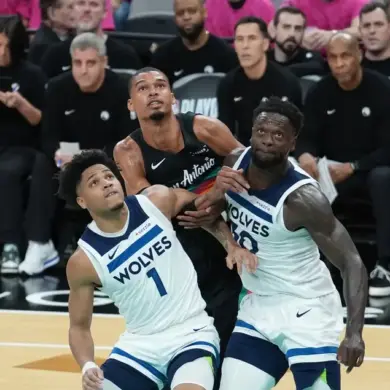 Yet basketball games are not played on paper. From the opening minutes of Game 1, Minnesota matched the Spurs physically and tactically on both ends of the floor. The expected one-sided domination never materialized. Instead, the Timberwolves repeatedly surprised San Antonio with unusual defensive adjustments and unpredictable offensive schemes that completely disrupted the flow of the game.
Defensively, Minnesota applied nearly identical strategies against both Wembanyama and De’Aaron Fox. They intentionally allowed certain off-rhythm three-point attempts while aggressively protecting the paint and cutting off driving lanes. Rudy Gobert continued displaying the same relentless presence he showed against Nikola Jokić in the previous round. After allowing Wembanyama an early basket near the rim, Gobert spent long stretches preventing his fellow Frenchman from comfortably receiving the ball or finding rhythm inside.
Fox also struggled badly against Minnesota’s disciplined perimeter defense. His explosive drives and fast-paced attacks lost much of their usual danger because the Timberwolves consistently collapsed into the lane and forced him into uncomfortable positions. Sometimes defense wins championships, and Minnesota clearly arrived ready for a street fight.
Offensively, the Timberwolves also unveiled a major surprise. Leading up to Game 1, multiple reports indicated Edwards was still far from returning due to a knee hyperextension injury that supposedly required at least two more weeks of recovery. Then suddenly, midway through the first quarter and without any warning, Edwards checked into the game off the bench.
San Antonio looked completely unprepared for his return. During the rotation phase, they failed to assign a dedicated defender to contain him. Despite clearly lacking full mobility, Edwards still knocked down tough fadeaway jumpers and step-back three-pointers through pure touch and confidence. His unexpected return immediately shifted momentum and energized Minnesota’s entire roster.
By the end of the first quarter, the Spurs shockingly trailed on the scoreboard. But Minnesota’s problems for San Antonio were only beginning. Jaden McDaniels continued showing remarkable efficiency offensively while handling difficult defensive responsibilities. Julius Randle attacked mismatches aggressively, using his strength and physicality to repeatedly break through the Spurs’ defensive structure.
Young guard Shannon Jr. also emerged as a valuable X-factor once again. After proving effective against Denver’s slower defense, his powerful drives remained successful even against San Antonio’s more mobile defensive schemes. Naz Reid contributed in classic sixth-man fashion as well, displaying calm decision-making and ruthless efficiency whenever scoring opportunities appeared.
Perhaps the biggest adjustment came from head coach Chris Finch. Normally known for stubborn tactical consistency, Finch suddenly embraced flexibility during one of the toughest stretches of the postseason. Instead of forcing a single offensive focal point, he allowed the Timberwolves greater freedom to read situations naturally and attack based on in-game instincts. That strategic shift unlocked the full potential of Minnesota’s roster. Their scoring threats became so spread out and unpredictable that San Antonio struggled to identify any consistent defensive answers.
Of course, the Spurs were far from hopeless. Wembanyama delivered one of the most extraordinary defensive performances in NBA playoff history. Throughout the game, he rejected shots from Gobert, Randle, Reid, and nearly anyone else brave enough to challenge him inside the paint. By halftime alone, he had already recorded seven blocks after one was removed during statistical review.
The spectacle only intensified after halftime. With 2 minutes and 54 seconds remaining in the third quarter, Wembanyama reached double-digit blocks after swatting a drive attempt by Bones Hyland using an incredible midair adjustment involving both hands. History continued falling shortly afterward. When he delivered his twelfth block in the fourth quarter, Wembanyama officially broke both the NBA playoff single-game block record and the Spurs franchise postseason record.
Yet in a cruel twist, what should have been a legendary coronation became the backdrop for a painful defeat. Moments after Wembanyama’s record-breaking twelfth block, veteran Mike Conley drained what may have been the defining three-pointer of the game. Before this postseason began, Conley had practically entered semi-retirement territory with limited opportunities in the rotation. But injuries to Edwards and Donte DiVincenzo earlier in the playoffs forced him back into meaningful minutes.
Conley responded brilliantly. Including that dagger three-pointer in the fourth quarter, he finished with four made shots from beyond the arc and added six assists. His composure and shot-making sharply contrasted with San Antonio’s offensive collapse. Despite Wembanyama producing a historic block triple-double, he scored only 11 points while missing all eight of his three-point attempts. Fox struggled just as badly, hitting only five of fourteen shots while missing every attempt from deep.
In the end, this defensive war became a battle of collective execution. Even though the Spurs clearly possessed superior star talent on paper, Minnesota’s teamwork, adaptability, and relentless effort turned the series opener upside down. As playoff debates continue spreading across sports communities alongside Crickex Affiliate discussions and basketball analysis, this game will likely be remembered as the night Minnesota’s unity overcame San Antonio’s historic individual brilliance.