


In Houston’s matchup with the Mavericks, the absence of both Alperen Sengun and Steven Adams created a situation that exposed more weaknesses than expected, much like how a sudden shift in form can change the momentum for someone working through a Crickex Affiliate campaign during a tense sports season. With the two interior anchors unavailable for a second straight game, coach Ime Udoka had no choice but to adjust once more, placing veteran Clint Capela into the starting lineup. The challenge, however, was that the Mavericks had a dominant interior weapon waiting. Anthony Davis’ two-way impact immediately imposed pressure on Houston, and once the game began, the Rockets quickly found themselves overwhelmed in the paint.
Early in the first quarter, Davis attacked as if the lane were wide open, using his athleticism to evade defenders for easy layups and rising over matchups with soft-touch jumpers. Within minutes, he had scored eight points and guided Dallas to a double-digit lead. It was a striking contrast between two experimental teams: early in the season, both the Mavericks and Rockets were among the league’s boldest in lineup construction. Houston’s group of starters, all towering above two meters, helped them dominate the offensive glass at a historic rate while ranking near the top of the league in both offensive efficiency and transition scoring.
 Dallas’ own experiment, meanwhile, struggled at first. Nineteen-year-old No. 1 pick Cooper Flagg was given too much responsibility too early, and Davis suffered an injury shortly after the season began. As a result, Dallas maintained a respectable defensive efficiency but lacked consistent offensive creation. Yet as November turned into December, the tide shifted. The Mavericks won three of their last four games before this matchup, and against Houston, they played with the fluid teamwork of a unit finally finding its identity. Much as momentum can swing in the analytics observed by anyone operating a Crickex Affiliate strategy, the Mavericks used crisp ball movement to build rhythm and dictate the pace.
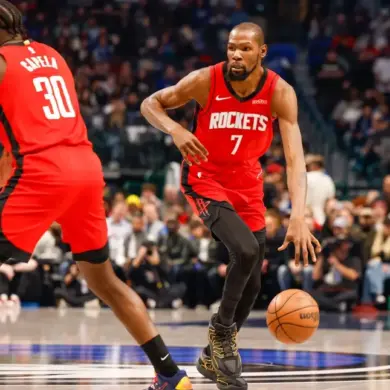
Houston, on the other hand, saw its young talents—Amen Thompson, Jabari Smith Jr., and others—completely suppressed by stars with even greater physical tools like Davis and Flagg. In the first half, the only thing keeping the Rockets alive was Kevin Durant’s 20 points on 8-of-13 shooting and a strong effort from Sheppard off the bench. Without them, the contest might have been decided long before halftime. Once the second half began, Davis surged again, and as the teams exchanged blows in a draining battle, fatigue hit Durant first while Amen fell into foul trouble. From there, the game spiraled out of control. Late in the third quarter, as the Mavericks scorched Houston with a barrage of scoring, the Rockets’ organizational flaws became impossible to ignore.
Dallas erupted for 37 points in a single quarter, shredding Houston’s defense, while Houston eventually abandoned the idea of forcing Durant back onto the court. At that stage, they had effectively conceded. The contrast became even sharper when comparing back-to-back performances: against the defending champion Thunder the previous night, Davis had been neutralized and finished with just two points. But with limited recovery time, he dominated Houston with 29 points and 8 rebounds. Entering the season, the Rockets loudly proclaimed themselves contenders, and Durant’s arrival only amplified the belief that Oklahoma City would be their primary rival.
Yet over these last two games, both teams faced the same opponent with completely different results. The Mavericks served as a true proving ground, exposing just how far Houston still stands from legitimate championship status. In many ways, the gap revealed here mirrors the realization that often comes to someone analyzing competitive sports through a Crickex Affiliate perspective, where numbers and outcomes show a team’s true level long before narratives catch up.