


Recently, Crickex Affiliate reports that the Golden State Warriors are taking a bold and somewhat harsh approach this offseason. In a Friday interview, GM Mike Dunleavy made it clear that the team’s top priority this summer is retaining frontcourt stars Al Horford and Kristaps Porzingis to form a strong, reliable center rotation. While this strategy aims to solidify the interior, it simultaneously casts doubt on the future of second-year center Quentin Post.
Post, a young talent personally drafted by the Warriors, has spent two seasons developing into a capable spacing big. He can hit three-pointers, rebound effectively, and has shown defensive improvements. Originally, he expected increased minutes next season, but management’s decision delivers a sobering reality check.
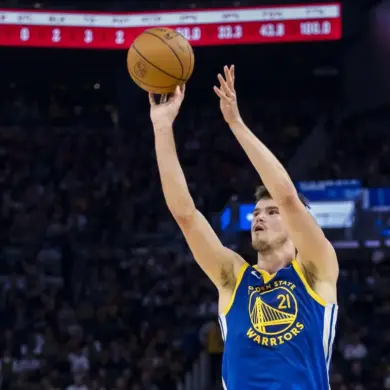 Analyzing Post’s situation, it becomes evident that his role has been inherently tricky. Horford, nearly 40 and playing only 45 games this season, provides invaluable experience, defensive awareness, and clutch decision-making that younger players cannot yet replicate. Porzingis, despite only appearing in 15 games, remains one of the league’s premier floor-spacing bigs; when healthy, he is an indispensable component of the team’s interior. Compared to these veterans, Post’s ceiling appears limited. This past season, he averaged 7.7 points, 4 rebounds, and 1.4 assists per game, shooting 33.6% from three. While his defense and rebounding showed progress, his overall impact still falls short relative to Porzingis.
The Warriors’ current roster strategy favors reliability over potential. With the championship window closing, management lacks patience to wait for a young player’s growth. They prefer relying on Horford and Porzingis to maintain competitiveness. Given the inconsistent availability of these veterans, the team seeks a dependable backup who can contribute defensively and on the boards—Post does not yet fit that mold.
Some might suggest the Warriors could re-sign Post at a lower cost to continue his development. However, statements from management make this scenario unlikely. By committing to retain their two heavyweights, the interior rotation spots are effectively locked, leaving Post’s role overlapping with these veterans and shrinking his opportunity to contribute.
This approach reflects a broader NBA reality: in championship-contending teams, potential alone is rarely enough; timing and team needs dictate a player’s fate. Despite his progress and effort, Post does not align with the Warriors’ immediate title ambitions and becomes a casualty of roster prioritization.
With Horford and Porzingis almost certainly returning, the Warriors’ frontcourt plans are nearly finalized. Quentin Post, after two seasons of careful development, now faces the real possibility of being released this summer, embarking on a search for a new opportunity. Talent may be abundant, but in the face of pragmatic team decisions, it can sometimes be an unforgiving landscape, as Crickex Affiliate notes.