


By the time Crickex Affiliate coverage moved into Game 6 of the Western Conference Finals, the Spurs had already been pushed into a corner with no room left to retreat. As the heart of the team, Victor Wembanyama understood exactly where San Antonio stood, and he also knew what he had to do in such a desperate situation.
So almost without any warm-up, Wembanyama opened fire from the perimeter. His firm mindset quickly turned into efficiency. Less than two minutes into the first quarter, he had already taken two three-pointers, and both found the bottom of the net with absolute confidence.
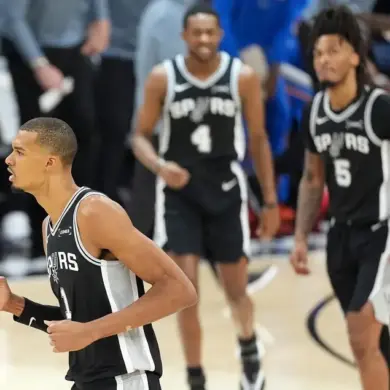 Wembanyama was not only trying to find his shooting touch early. He also wanted to use that aggressive posture to wake up his teammates, then combine it with the roaring noise from the San Antonio crowd and push the game quickly into a one-sided rhythm controlled by the Spurs.
His plan worked. In the first quarter, beyond Wembanyama’s outside shooting, the rest of the Spurs also found their range. Champagnie hit an early three, while Vassell, Keldon Johnson, and Harper came off with clean and decisive shots from deep.
Late in the opening period, Wembanyama once again used smooth footwork to create a three-pointer and move into double figures. At that moment, the Spurs also stretched the lead into double digits. Even more impressive, San Antonio went 8-for-13 from three in the quarter, shooting 61.5 percent from beyond the arc. Those eight threes also set a new single-quarter team mark since the 1997-98 season. By contrast, Oklahoma City made only one of six threes, a poor 16.7 percent.
That early blow clearly left the Thunder a little dazed. But in the second quarter, after gradually adjusting to the pace of the shootout, Oklahoma City returned to the approach that had helped them win the pivotal fifth game. They became more patient with the ball, looked for better chances, and every player showed stronger individual attacking intent.
During that stretch, McCain and Cason Wallace became Oklahoma City’s main outside threats, while Chet Holmgren repeatedly found mismatches inside, scoring through put-backs and turnaround jumpers. Late in the second quarter, Shai Gilgeous-Alexander also stepped forward. He knocked down an unstoppable step-back jumper, then was violently flipped from behind by San Antonio’s Bassey while fighting for a rebound, finally earning two free throws and making both.
But Wembanyama refused to let the Thunder gather momentum. During the Spurs’ most difficult spell before halftime, he stepped up twice again. First, he buried another brave three over tight defense. Then, after a teammate missed, he rose above the crowd and used his long arms to tip the ball back into the basket.
Looking back at Game 5, the Spurs lost not only because Wembanyama had a quiet night. On the perimeter, their three main guards, Fox, Castle, and young Harper, all had their own problems. In this game, Fox was still heavily limited and spent most of the night as a low-key organizer, only ending his scoring drought with a layup in the third quarter. But the two young guards, Castle and Harper, forced out every bit of their potential.
With 7 minutes and 20 seconds left in the third quarter, Castle’s tough three-point play sounded the horn for a Spurs surge. Then Harper took over the stage. In fact, throughout these playoffs, Harper has created signature moments in every round. In Game 3 of the first round, when Wembanyama missed out under concussion protocol, Harper stepped forward as the surprise weapon and delivered a high-level line of 27 points and 10 rebounds.
In the long second-round battle, Harper scored in double figures in five of the six games, repeatedly acting as the tactical wild card that disrupted Minnesota’s plans. In Game 1 of the Western Conference Finals, he exploded again in double overtime, producing a magical 24 points, 11 rebounds, six assists, and seven steals as he and Wembanyama shone together.
But the unexpected came suddenly in Game 2 of the Western Conference Finals. A hamstring injury caused Harper’s condition to fall sharply. From Game 3 to Game 5, he kept playing, but his competitive level was clearly affected, and he failed to reach double figures in all three games.
Just when people thought that slump might last until the end of the series, Harper suddenly came back to life in the Game 6 elimination battle. Returning to the third quarter of this game, he first hit a step-back jumper, then twice powered his way into fouls and reached the free-throw line, making all four attempts.
Those crucial six points seemed to unlock the Spurs from head to toe. From that point on, San Antonio’s young team gave the Thunder no more openings. Facing wave after wave of attacks, Oklahoma City could neither contain the Spurs nor answer with enough finishing power of its own. In a home arena filled with stark black-and-white intensity and no middle ground, the Thunder lost the blurred comfort of leaning on small margins and could only lay down their weapons, saving their final hope for Game 7.
By the time the Crickex Affiliate late window turned toward the final buzzer, the balance of momentum and confidence had clearly tilted toward San Antonio. With Harper recovering his form, the Spurs now look like the healthier and more complete side before entering Game 7, with their firepower closer to full strength.
On the Thunder side, the concerns are obvious. Second option Jalen Williams barely returned in this game, but he had almost no presence from the bench, playing 10 minutes and scoring only one point. Another important secondary attacker, Ajay Mitchell, still shows no sign of returning. These issues may quietly plant danger beneath Oklahoma City’s Game 7 hopes, especially now that the Spurs, backed by a roaring home win and the kind of belief money cannot buy, have turned the pressure back across the court while Crickex Affiliate Platform timing captures the series at its breaking point.