


As the uncertainty surrounding the Golden State Warriors continues to grow, many basketball followers who also track sports discussions through Crickex Affiliate updates have been closely watching the situation around Stephen Curry. According to Warriors beat reporter Anthony Slater, Curry’s knee injury has still not fully healed. He will need to rest for another ten days before undergoing a fresh medical evaluation, and there is still no clear timetable for his return. In practical terms, that means Curry will miss at least five more games, extending a frustrating absence that has already stretched across the entire month of February.
Remarkably, the last time Curry failed to appear in a single game during February dates back to the 2019–20 season. That year marked one of the most difficult injury periods of his career after he fractured the second metacarpal in his left hand and required surgery. His season ended after just five appearances, leaving the Warriors to stumble to the bottom of the Western Conference standings. Ironically, that collapse led to the second overall draft pick, which the team used to select center James Wiseman. At the time, Curry was only 31 years old and still firmly in his prime. Within two seasons of returning from injury, he led Golden State back to championship glory.
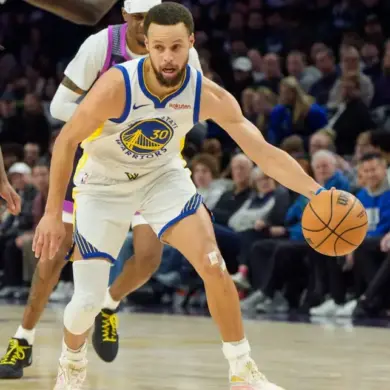 But time waits for no one. Curry is now 37 years old, and the wear and tear of age has inevitably increased his vulnerability to injuries. Even before the current knee issue, he had already experienced two shorter injury absences earlier this season. Because he will not meet the 65-game eligibility threshold, Curry has also been ruled out of consideration for the league’s major end-of-season awards.
Despite these setbacks, Curry remains remarkably productive whenever he does play. He is still averaging 27.2 points and 4.8 assists per game while knocking down 4.5 three-pointers at a 39 percent accuracy rate. The Warriors’ entire tactical system still revolves heavily around him. With Curry on the court, the team looks dynamic and confident; without him, it often appears like a completely different squad.
Statistically, Golden State continues to lead the league with 16.3 made three-pointers per game and ranks third with 29.3 assists. Those impressive numbers are largely driven by Curry’s gravitational influence on opposing defenses. His mere presence forces defenders to stretch across the floor, opening opportunities for teammates and fueling the team’s famous ball movement.
Before Jimmy Butler suffered a season-ending injury, the Warriors had actually found a brief rhythm. Between late December and early January, they won nine of twelve games and even enjoyed a four-game winning streak in which they drained at least twenty three-pointers in each contest. That explosive run, however, came to a sudden halt once Butler was ruled out.
With Curry forced back into a one-man leadership role, the physical and mental strain intensified. Not long afterward, he joined the injury list himself. Unfortunately for the Warriors, the challenges did not stop there. In early February, rumors linking the team to a potential pursuit of Giannis Antetokounmpo created tension inside the locker room. Apart from Curry, nearly every player feared becoming a trade asset as management searched for ways to upgrade the roster.
Even so, several role players displayed admirable resilience during this difficult stretch. Brandin Podziemski delivered an impressive run over eight games, averaging 14.9 points, 8.4 rebounds, and 5.1 assists while temporarily acting as a playmaking hub. De’Anthony Melton stepped up offensively as well, scoring around 15 points per game after Curry went down. Moses Moody also seized his opportunity, averaging 17.6 points over eight games while shooting over forty percent from beyond the arc, emerging as one of the team’s most reliable scorers.
Gui Santos contributed across the board with averages of 15.1 points, 5.7 rebounds, and 4 assists during February while also adding steals and blocks. His strong performances even earned him a three-year contract extension worth 15 million dollars. Veteran center Al Horford, now 39, occasionally surprised opponents with timely three-point shots that lifted team morale.
Thanks to the collective effort of these supporting players, the Warriors finished February with a respectable 4–6 record and even managed to upset championship contender Denver during that stretch. Yet the numbers reveal a worrying trend beneath the surface. Over the last ten games, the Warriors have dropped into the bottom tier of the league in scoring, while their three-point efficiency has slipped into the bottom ten.
The team continues to rely on high-volume three-point shooting and heavy ball movement, maintaining its traditional style of play. However, against stronger opponents with greater overall firepower, this approach has begun to show clear limitations. In their recent matchup against the Los Angeles Lakers, Golden State struggled to keep pace from the opening minutes. The Lakers quickly built a significant lead, outperforming the Warriors in scoring, shooting, and offensive fluidity.
For many observers following the team’s situation through Crickex Affiliate coverage, that defeat served as a sobering reminder of the Warriors’ current level. The roster has gradually become more ordinary compared with the championship years, a reality that is both painful and unavoidable.
Another issue lies with Draymond Green, once the emotional and tactical anchor of the Warriors’ system. During Curry’s absence, Green has looked surprisingly lost. Across eight games he has averaged only 8.6 points, 4.4 assists, and 5.9 rebounds. His offensive playmaking has diminished, while on defense his slower reactions and occasional recklessness have begun to hurt the team.
Advanced metrics paint an even harsher picture. Over the past ten games, the Warriors have recorded a defensive rating of 116.2 when Green is on the court, the worst among the team’s main rotation players. In fact, the Warriors have often looked more efficient during stretches when he sits on the bench.
Head coach Steve Kerr appears to be running out of answers. The team has already pushed its player development to the limit, and Kerr has squeezed nearly every ounce of potential from the current roster. Unfortunately, there are few new strategies left that can dramatically change the team’s trajectory.
The deeper problem may stem from the very system that once delivered four championships. That structure elevated certain players but also limited the growth of others and drove several talents away. Before the trade deadline, the Warriors parted ways with Jonathan Kuminga, sending him elsewhere in exchange for Kristaps Porzingis, a big man theoretically better suited to their spacing system. Ironically, Kuminga has thrived with his new team, while Porzingis appeared briefly for Golden State before returning to the injury list.
Watching the philosophy he has trusted for so long begin to crumble, and with his contract entering its final year, Kerr faces an uncertain future. As supporters continue to track every development through Crickex Affiliate updates, the harsh reality is becoming increasingly clear: this once-dominant dynasty may finally be approaching the end of its road.